Upright Vacuum Cleaners: History, Technology, and Independent Rankings
Upright vacuums still clean carpet better than most sticks and robots. A sealed bag and real HEPA filtration keep dust in the machine instead of blowing it back into the room.
This guide covers how uprights evolved, why true twin motors matter, and how we rank machines we sell and service in Myrtle Beach.
A short history
Early machines were huge and needed two people to pump the bellows. Homes did not get a practical electric vacuum until 1907, when James Spangler built a portable unit with a fan motor, a broom handle, and a pillowcase. He wanted less dust because of his asthma. William Hoover bought the idea and turned it into a household product.
After World War II, wall-to-wall carpet spread across American homes. Uprights with a spinning brush and strong suction became the standard. That job has not changed. The machines have.
Electrolux of Sweden pioneered sealed bag systems. The company later acquired Eureka. The American direct-sales arm became Aerus. Aerus kept a premium service model. Eureka changed owners and moved down-market.
Miele built its name on European engineering and filtration. Tacony built the Riccar and Simplicity lines in the United States and developed Tandem Air: two full motors for airflow and cleaning, not a toy motor on the brush.
One motor versus two
Most uprights use one motor. It has to spin the brush and pull air at the same time. When the bag fills or the brush hits thick carpet, suction drops.
Some brands, including certain Aerus uprights, add a smaller second motor. That motor mainly spins the brush. Main airflow still comes from one fan. Tool suction falls off when the carpet head is working hard.
Riccar Tandem Air is different. Both motors move air. One works the nozzle and brush. The other keeps hose and tool suction strong, in a direct-air style closer to Kirby, with extra airflow that helps the brush and the wand. You can clean stairs and furniture without starving the carpet head.
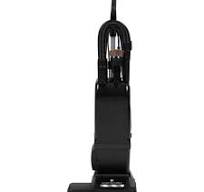
Electrolux Areus
Belts and what they cost you
Designated Riccar Tandem Air models carry a lifetime belt warranty on the gear or cog drive. Kirby-style friction belts stretch and often need changing every few months. SEBO and some Aerus units use gear or cogged belts that last far longer than a cheap rubber band.
Belt type is ownership cost. A “bargain” upright that eats belts is not cheap.
Why we bonus Made in America and Europe
Online star ratings miss what we see on the bench.
Machines built in the United States and Europe usually use thicker housings, metal brush rolls, replaceable belts or gear drives, and motors that can be rebuilt. Parts stay available. We can fix them in our shop.
Many Asia-sourced box-store uprights use thin plastic, short-life friction belts, and sealed motors. They can clean well when new. In two or three years the body cracks, the belt glazes, and parts disappear.
The Ron Score adds a bonus for U.S. or European manufacture because of build quality, service life, and cost after the warranty fades. We also bonus true sealed HEPA, warranties longer than two years, and metal parts you can replace. Models made primarily in Asia get no origin bonus.
Key differences: U.S. and Europe vs many Asia-sourced machines
Hazardous materials. Europe’s RoHS and REACH rules limit lead, mercury, cadmium, hexavalent chromium, certain flame retardants, and a long list of other chemicals. The United States is stricter on children’s products (lead limits under CPSIA) and California adds Prop 65 warnings. China has its own RoHS-style rules on paper. The gap is often enforcement and how much of the supply chain is actually tested.
Lead in paint and solder. Old lead paint is a bigger issue in toys and cheap imported housewares than in a modern name-brand vacuum’s. Where it still shows up is low-cost electronics: leaded solder, cheap coatings, and parts that never saw a real RoHS check. U.S. and EU factories building for those markets have to stay under the limits or they cannot ship.
Labor rules. The U.S. and EU ban child labor and have workplace-hour and safety laws with real inspectors. China has labor laws on the books. Enforcement down the supplier chain is uneven. The U.S. also blocks imports tied to forced labor. We cannot see inside every factory. We can see which brands still sell parts and stand behind a worker-safety audit.
Pollution and power. U.S. EPA and EU factory rules limit air and water discharges. A lot of high-volume appliance production still runs on coal-heavy grids and looser local enforcement. That is not a vacuum spec. It is why two machines that look alike can have a very different footprint.
Repair and parts. Europe is moving hardest on repairability. France even scores vacuums on a repair index and pushes spare parts. U.S. shops like ours can rebuild a Riccar, Simplicity, SEBO, or Miele for years. Many box-store uprights are sealed plastic. When the motor dies, the whole unit is trash.
What that means for the Ron Score. The origin bonus is for thicker housings, metal brush rolls, rebuildable motors, available parts, and factories that have to meet U.S. or EU chemical, labor, and pollution rules. It is not a claim that every overseas plant breaks the law. It is a claim about what we can service and what holds up in a coastal home.
Ron Score method
We start with a composite of independent carpet, bare-floor, emissions, and handling results. Then we add the bonuses above. The number is our shop rating after more than fifty years of selling and repairing these machines.
Robot vacuums get a zero for above-floor cleaning. They cannot do furniture, stairs, or drapes. Mapping is fine. Deep carpet and tools are not their job.
Comparison table: uprights with tools
| Model / Brand | Motor type | Belt / drive | Filtration | Origin | Tools | Ron Score |
|---|---|---|---|---|---|---|
| Riccar R40 / R40P Tandem Air | True twin airflow plus brush | Lifetime gear / cog | Sealed HEPA | USA | Yes | 9.8 |
| Simplicity S40P / S40 series | True twin airflow plus brush | Long-life | Sealed HEPA | USA | Yes | 9.4 |
| SEBO Felix / uprights | Single or powerhead | Gear / cogged | Excellent | Europe | Yes | 8.7 |
| Aerus uprights | Main plus small brush motor | Gear options | Strong | Varies | Yes | 8.5 |
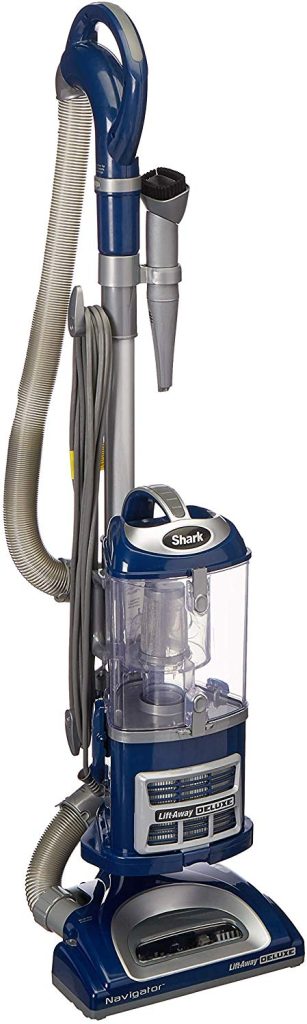
| Shark Stratos / EXT | Single or dual brush motor | Standard belt | HEPA claimed | Asia | Yes | 7.8 |
| Dyson Ball Animal | Single cyclonic | Direct | Strong | Asia-sourced | Yes | 7.7 |
| Bissell uprights | Single | Friction belt | Basic | Asia / China | Yes | 6.9 |
Riccar leads because both motors make real airflow, the gear drive lasts, and the machine is built here. Simplicity is the sister line from the same factory. The S40P and S40-series share the dual-motor idea. Higher models add sealed HEPA. The score gap is features and positioning, not a different core design.
SEBO is the European pick: tight filtration, a gear drive, and parts we can service.
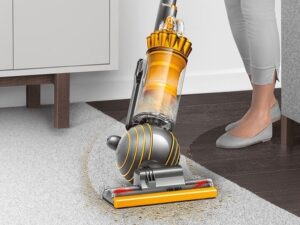
Dyson Ball Upright Vacuum
Shark and Dyson can look strong on a showroom carpet. They lose points on sealed bags, long-term parts, and what happens when a plastic hinge or cyclone clogs.
What to buy
Choose Riccar or Simplicity Tandem Air for mixed carpet, pets, and tools that still suck. Choose SEBO for a lighter European upright with first-class filtration. Come in if you want to see it on carpet, not on a spec sheet.
Carolina Forest Vac & Sew
7613 SC-544, Myrtle Beach, SC 29588
843-903-6299
Free shipping in the lower 48. No sales tax outside South Carolina.
About the author
Ron Mancil has worked in the vacuum and sewing machine industry for more than 50 years. He operates Carolina Forest Vac & Sew in the Myrtle Beach area and rates machines on cleaning, filtration, and whether we can still fix them years later.