Juki Sewing Machines: Industrial Platforms, QVP Lines, and Precise Model Relationships
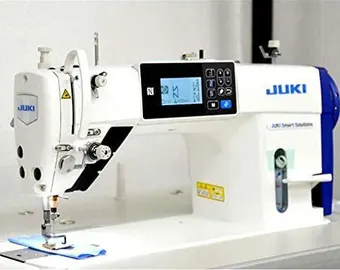
Juki is one of the world’s leading industrial sewing machine manufacturers. The same engineering principles that power its factory machines appear, in scaled form, in its domestic and semi-professional lines. Because of this shared DNA, many people search “Juki sewing machine for sale” without knowing exact model numbers. Understanding the platforms, throat space, and key differences between lines is the fastest way to match a machine to real work. Note prices are subject to change, links to each product page with current price are highlited and subject to change.
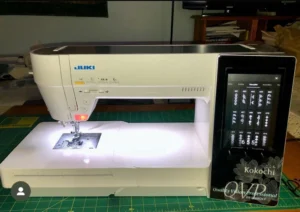
- Box Feed Mechanism: The feed dogs move in a perfect rectangle rather than an oval. This ensures maximum fabric contact, preventing puckering on silks and slipping on heavy denims.
- Sub-Tension Unit: An auxiliary tension disk that straightens the thread before it enters the main tension assembly. It eliminates thread twists, nesting, and loops at high speeds.
- Float Function (Micro-Lifter): Allows the presser foot to hover micro-millimeters above the fabric. This stops wavy seams on stretchy knits and prevents bunching on thick quilt batting
Why Throat Space Matters
Throat space is the open area to the right of the needle. Larger throat space makes it far easier to handle quilts, bulky garments, and multi-layer projects without constant fabric rolling or repositioning.
- Compact / entry machines: roughly 5.5–6.7 inches
- Full-size domestic machines: approximately 8 inches (height typically 4.0–4.5 inches)
- Higher QVP models: 12 inches wide × approximately 4.7 inches high
- Long-arm (J-350QVP Miyabi): approximately 18 inches
The jump from 8 inches to 12 inches (and especially to 18 inches) is one of the most practical upgrades for serious quilters.
Industrial Foundations
Juki began industrial production in 1953. Core platform codes include:
- DDL — Single-needle lockstitch (apparel workhorse)
- MO — Overlock / safety-stitch
- LU / DNU — Walking-foot / compound-feed for heavy materials
- LH — Two-needle lockstitch
These platforms emphasize durability, consistent feed, and high-speed reliability. Those same priorities appear in domestic lines in modified form.
Top Industrial Models – Key Features, Materials & Specs
1. DDL-8700 / DDL-8700-7 Single-needle lockstitch. The industry standard for medium-weight production.
- Materials: Light to medium-weight fabrics (cotton, polyester, twill, poplin, light denim, broadcloth). The “H” subclass handles heavier materials.
- Key Features: High-speed sewing up to 5,500 SPM, low vibration/noise head, automatic lubrication, 13 mm knee presser-foot lift, easy stitch-length dial, throat-plate seam guides.
- Core Specs: Max stitch length 5 mm • Needle system DB×1 (#9–#18 standard) • Auto-lubricating full-rotary hook • Machine-head weight ≈ 28 kg.
2. DDL-9000C Series Direct-drive digital lockstitch (the modern evolution of the DDL line).
- Materials: Medium-weight to heavy-weight depending on subclass. Excellent on apparel fabrics, denser weaves, and some light leather.
- Key Features: Direct-drive servo motor, digital feed control, semi-dry or minute-quantity lubrication, high presser-foot lift (up to 15 mm by knee).
- Core Specs: Max speed 4,500–5,000 SPM • Max stitch length 5 mm • Needle DB×1 or DP×5 • Bed size ≈ 517 × 178 mm.
3. DNU-1541 / DNU-1541S Unison-feed (walking-foot) lockstitch — the classic heavy-duty workhorse.
- Materials: Leather, vinyl, upholstery, canvas, coated fabrics, webbing, multi-layer denim, marine fabrics.
- Key Features: True walking-foot + needle + feed-dog unison feed, alternating vertical movement up to 6.5 mm, rectangular feed, double-capacity hook, dual-tension system, safety clutch on the “S” model, 16 mm knee lift.
- Core Specs: Max speed 2,500–3,000 SPM • Max stitch length 9 mm • Needle 135×17 (Nm 125–180) • Needle-bar stroke 36 mm • Head weight ≈ 36–42 kg.
4. MO-6700 / MO-6800 Series High-speed overlock / safety-stitch machines.
- Materials: Light to heavy-weight knits and wovens — T-shirts, activewear, denim, light outerwear, lingerie.
- Key Features: Speeds up to 7,000 SPM, differential feed, soft well-tensed seams, optional semi-dry heads.
- Core Specs: Stitch length 0.6–3.8/4.5 mm • Overedging widths 1.5–6.4 mm • Needle DC×27 • Max presser-foot lift 7 mm.
5. LU-1508N / LU-1510 Series Heavy-duty unison-feed lockstitch with large vertical-axis hook.
- Materials: Thick leather, upholstery, canvas, ballistic nylon, multi-layer webbing.
- Key Features: Unison feed with rectangular feed motion, dual-tension system, 16 mm presser-foot lift, large-capacity hook.
- Core Specs: Max speed 2,000–3,000 SPM • Max stitch length 9–10 mm • Needle 135×17 or 190R • Needle-bar stroke 36–38 mm.
These industrial platforms share the same engineering philosophy — robust construction, consistent feed under load, and long service life — that Juki later adapted into its domestic and QVP lines.
The “Fine-Print” Realities: True reference quality requires absolute transparency. An educational page must explicitly warn users that choosing an industrial platform means dealing with a stationary 80-pound table, localized power needs, and a strict sacrifice of zigzag or buttonhole capabilities.
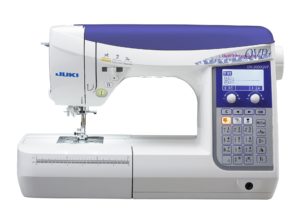
Juki DX 2000 QVP
Entry-Level Domestic Machines
Best for learning, light garment work, and smaller projects.
| Model | Type | Stitches | Throat Space | Max Speed | Notable Features |
|---|---|---|---|---|---|
| HZL-353ZR-C | Mechanical | 21 | ~5.5–6 in | 750 SPM | Auto needle threader, 1-step BH |
| HZL-355ZW-A | Mechanical | 26 | ~5.5–6 in | 750 SPM | Auto needle threader, free arm |
| HZL-LB5020 | Computerized | 20 | ~6.5–6.7 in | 700 SPM | LCD, start/stop, 7-point feed |
| HZL-LB5100 | Computerized | 100 | ~6.5–6.7 in | 700 SPM | Expanded stitch selection |
| HZL-70HW | Computerized | 80 | ~6.3–6.5 in | 800 SPM | Compact free-arm |
| HZL-80HP-A | Computerized | ~197 + font | ~6.3–6.5 in | 800 SPM | Lettering, higher stitch count |
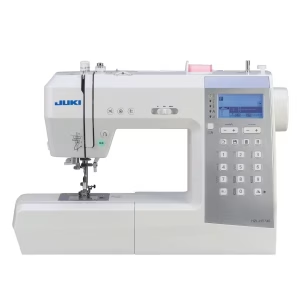
HT JUKI 740
Travel / Compact Class (HT Series)
Lightweight machines for small spaces or occasional travel.
| Model | Stitches | Throat Space | Max Speed | Key Features |
|---|---|---|---|---|
| HZL-HT710 | 60 | ~6.5 in | 70–800 SPM | Auto thread trim, compact |
| HZL-HT740 | 116 + 2 fonts | ~6.5 in | 70–800 SPM | Auto trim + lettering |
Full-Size Domestic Machines
G Series (approx. 8-inch throat)
- HZL-G120
- HZL-G220 (adds automatic thread trimming)
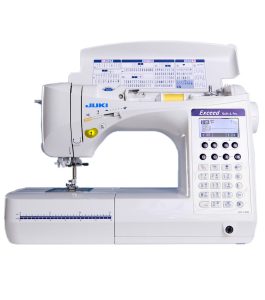
F Series (Exceed) — stronger accessory support and box-feed mechanism.
| Model | Stitches + Fonts | Throat Space | Knee Lift | Extension Table | Walking Foot | Notes |
|---|---|---|---|---|---|---|
| HZL-F300 | 106 + 3 fonts | ~8 in | Optional | Optional | Available | Base Exceed model |
| HZL-F400 | 157 + 3 fonts | ~8 in | Yes | Optional | Included/available | Knee lift standard |
| HZL-F600 | 225 + 4 fonts | ~8 in | Yes | Included | Included | Most complete Exceed package |
Higher QVP / DX Models – Detailed Comparison
| Feature | DX-3000QVP (Sayaka) | DX-4000QVP (Kokochi) | DX-4500QVP (Hayate) |
|---|---|---|---|
| Throat Space | 12″ × ~4.7″ | 12″ × ~4.7″ | 12″ × ~4.7″ |
| Stitches + Fonts (Official) | 351 + 4 | 368 + 4 | 368 + 4 |
| Smart Feed (Dual Feed) | Yes | Yes | Yes |
| Display | Color Touch | 7″ Color Touch | 7″ Color Touch |
| Automatic Needle Threader | Yes | Yes | Yes |
| Bobbin Thread Sensor | Yes | Yes | Yes |
| Adjustable LED Lighting | Limited | Yes | Yes (color temperature) |
| Soft Cover with Storage | Yes | Yes | Yes |
| Best For | Best value 12″ machine | Best balance of features & price | Flagship / fullest package |
Juki Smart Feed is a built-in dual-feed system that moves the top layer of fabric in sync with the bottom feed dogs. It is adjustable in fine increments and works with many decorative stitches — a major advantage over traditional walking feet.
Who Should Buy Which Model
-
Who Should Buy Which Model
DX-3000QVP (Sayaka) Best value 12-inch machine with Smart Feed. Ideal if you want the large throat and dual-feed capability without paying for the fullest accessory package or the most refined touchscreen experience. This is the smartest choice for quilters who primarily need the workspace and even feeding of multi-layer projects, but do not require every premium convenience feature. Excellent entry point into the 12-inch QVP lineup.
DX-4000QVP (Kokochi) Excellent balance of features and price. Nearly identical sewing performance to the DX-4500QVP for the vast majority of users. It offers the same 12-inch throat, Smart Feed, and high stitch quality, with a large color touchscreen. Choose this model if you want most of the flagship experience at a more approachable price point and do not need the absolute fullest accessory kit or the most advanced lighting controls.
DX-4500QVP (Hayate) Flagship choice for advanced quilters, serious garment makers, and professionals. This is the model to select when you want the most complete package currently available in the QVP line. It includes the fullest set of accessories, refined adjustable LED lighting (including color temperature control), and the highest level of convenience features. Best for users who sew frequently, work with thick or multi-layer projects, and prefer maximum out-of-the-box capability and long-term comfort.
→ Full details and current pricing: Juki DX-4500QVP Hayate product page
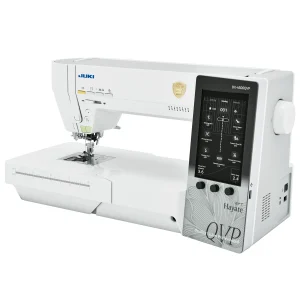
DX4500 QVP
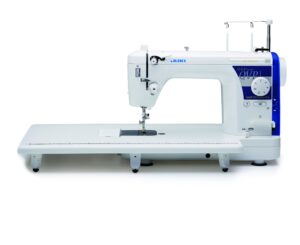
TL Series – Semi-Industrial Straight Stitch
The Juki TL series is a family of high-speed, straight-stitch-only machines built with industrial-inspired engineering. These machines are designed for users who need exceptional stitch quality, speed, and durability for quilting, piecing, bag making, and heavy straight-seam work.
All current TL models share these core strengths:
- Aluminum die-cast frame for rigidity and reduced vibration
- 8.5″ × 6″ throat space
- Maximum speed of 1,500 stitches per minute
- Vertical full-rotary hook
- Automatic needle threader
- Extension table included
- High shank design
TL Series Comparison Chart
| Feature / Benefit | TL-2000Qi | TL-2010Q | TL-15 | TL-18QVP (Haruka) |
|---|---|---|---|---|
| Max Speed | 1,500 SPM | 1,500 SPM | 1,500 SPM | 1,500 SPM |
| Float Function (Micro-Lift) | No | No | No | Yes |
| Sub Tension Unit | No | Yes | Yes | Yes |
| Speed Control Slider | No | Yes | Yes | Yes |
| Needle Up/Down Button | Limited | Yes | Yes | Yes |
| Slow Motion Stitch | No | No | No | Yes |
| Attached Mounting Plate | No | No | No | Yes |
| Accessory Package | Basic | Good | Better | Most complete |
| Best For | Budget entry | Proven workhorse | Modern balanced choice | Advanced quilters |
Model Summaries
TL-2000Qi Entry-level model in the series. It delivers the same industrial-style stitch quality and high speed at the lowest price point. Best suited for users who primarily sew long, straight seams and want a pure straight-stitch machine without extra control features.
Major Disadvantage of the TL-2000Qi The most significant limitation is the lack of a speed control regulator (speed control slider). All higher models include this feature, which allows the user to set a maximum sewing speed. Without it, the TL-2000Qi runs at full foot-pedal power up to 1,500 SPM. This makes fine speed control more difficult when sewing curves, tight turns, garments that require precision, free-motion quilting, or detailed piecing. For users who regularly work on curved seams or detailed projects, the missing speed control is a meaningful drawback and a strong reason to choose the TL-2010Q or higher.
TL-2010Q The long-time classic and most widely known model in the series. It adds a speed control slider, sub-tension unit, and better overall control compared with the TL-2000Qi. Still one of the most popular choices for serious quilters and bag makers who want proven reliability and consistent performance.
TL-15 A refined mid-range option that improves on the TL-2010Q with a more modern feel and strong feature set. It offers an excellent balance of control, power, and usability for quilting, piecing, bags, and general straight-stitch work.
TL-18QVP (Haruka) Current flagship of the series. In addition to the core TL strengths, it includes the exclusive Float Function (micro-lift) that allows the presser foot to hover slightly above the fabric—especially useful for thick seams and free-motion work. It also features slow-motion stitch capability, an attached mounting plate, and the most complete accessory package. Best choice for advanced quilters who frequently sew over thick layers or want maximum control and convenience.
Important Limitation
All TL series machines are straight-stitch only. They cannot sew zigzag, decorative stitches, buttonholes, or lettering. Most owners pair a TL with a computerized machine (such as a DX or F-series model) for decorative work.
Who Should Buy a TL Series Machine
Choose a TL series machine if your primary needs are high-speed, high-quality straight stitching for quilting, piecing, bag making, or heavy seams, and you value industrial-level durability in a home-sized machine. Select the TL-2010Q or higher if you need precise speed control for curves and detailed work. Choose the TL-18QVP if you want the most advanced features currently available in the series.
Long-Arm: J-350QVP Miyabi
The Juki J-350QVP Miyabi is Juki’s long-arm quilting machine, designed for serious free-motion and regulated quilting. The name “Miyabi” means elegance in Japanese, reflecting its smooth performance and refined engineering.
Key Specifications
- Throat space: 18 inches horizontal × 10 inches high (notably taller than many long-arms that offer only 8 inches of height)
- Maximum speed: 2,200 stitches per minute
- Built-in JUKI SmartStitch stitch regulator system (image-sensor based)
- Direct-drive AC servo motor
- Double-capacity “M” style bobbin
- Machine head weight: approximately 57 lbs
- Made in Japan
Four Stitch Modes
- Cruise — Free-motion quilting with stitch regulation
- Precise — Regulated stitching optimized for use with rulers
- Baste — Controlled basting stitches
- Manual — Free-motion without regulation
Frame Options The machine is available in multiple configurations:
- Sit-down table version
- 5-foot frame
- 7-foot frame
- 10-foot frame
- 12-foot frame (often achieved with an optional extension)
Frames feature solid steel construction, adjustable height, and a quick-release bar system.
Additional Features
- Large color LCD touchscreen for mode selection, speed, stitch length, lighting, and thread trimming
- Directional high-intensity LED lighting above the needle
- Automatic or manual thread trimming with thread lock options
- Built-in independent bobbin winder
- Optional rear handlebars and software integration (such as Quilter’s Creative Touch)
Who Should Buy the J-350QVP Miyabi This machine is best suited for quilters who regularly work on larger quilts and want consistent stitch length at varying speeds. The combination of the generous 18″ × 10″ throat space and the SmartStitch regulator makes it a strong choice for both free-motion and ruler work. Choose this model when a domestic or mid-arm machine no longer provides enough space or control for the size and complexity of your projects.
Important Consideration Long-arm machines require significantly more floor space than domestic or TL-series machines and represent a larger investment. They are ideal for dedicated quilting spaces rather than occasional use.
Throat space approximately 18 inches. Available as head-only, sit-down table, or on 5-ft to 12-ft frames. Built-in stitch regulation produces consistent free-motion quilting.
Sergers
Juki offers two main categories of sergers (overlock machines) for home and studio use: traditional manual-threading models and modern air-threading models.
Basic Manual-Threading Models (MO-600 Series)
Examples include the MO-644D and MO-654DE. These are the lowest-cost entry point into Juki overlock machines. They use traditional looper threading, offer differential feed, and can produce rolled hems. Setup requires carefully threading the loopers by hand, which typically takes 10–20 minutes and can be frustrating for beginners or infrequent users.
Approximate Street Price Range: $400 – $600
Air-Threading Models
Air-threading technology uses a burst of air to thread the loopers in seconds instead of minutes. This is one of the most significant usability improvements in modern sergers.
| Model | Key Features | Approx. Street Price Range |
|---|---|---|
| MO-1000 | Air threading, solid entry-level air model | $1,200 – $1,400 |
| MO-2000QVP | Air threading + LCD guidance | $1,400 – $1,600 |
| MO-2800 | Air threading, knee lifter | $1,500 – $1,700 |
| MO-3000QVP (Akane) | Air threading, automatic thread supply, chain-off cutter, micro-lifter, knee lifter | $2,100 – $2,500 |
Model Summaries
- MO-1000 — Entry-level air-threading serger. Delivers the major convenience of air threading at the lowest price among the air models. Best for users who want to move away from manual threading without paying for extra features.
- MO-2000QVP — Adds an LCD screen with step-by-step guidance and tension recommendations. Helpful for beginners or anyone who prefers visual assistance while learning or changing threads.
- MO-2800 — Strong mid-range choice with air threading and a knee lifter. Excellent everyday performance and good control without the highest price.
- MO-3000QVP (Akane) — Current flagship. Includes automatic thread supply, chain-off thread cutter, micro-lifter, and knee lifter. Designed for maximum convenience and the smoothest overall experience.
Key Advantage of Air Threading Traditional serger threading often takes 10–20 minutes and is a common source of frustration. Air-threading models reduce that process to just a few seconds, making the machine far more practical for frequent use or for users who change thread colors often.
Who Should Buy a Juki Serger Choose a manual-threading model only if budget is the primary concern. For most users, an air-threading model is strongly recommended. The MO-1000 is the best entry point into air threading, while the MO-2800 or MO-3000QVP are better choices for those who want additional convenience features.
Note: Prices are approximate street prices as of mid-2026 and can vary by dealer, promotions, and location. Always confirm current pricing with an authorized dealer.
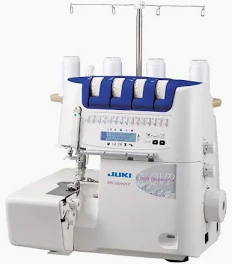
Juki MO 2000 Auto Air threading Serger
[Juki MO 2000 Auto Air threading Serger]
MCS-1700QVP Coverstitch & Chain Stitch
Dedicated coverstitch (2/3/4-thread) plus chain stitch for professional hems and stretch seams. Approximate speed 1,350 SPM.
Quick Decision Guide
| Your Main Need | Recommended Direction |
|---|---|
| Learning / light sewing / budget | Entry-level HZL (353, 355, LB, 70/80) |
| Portability | HT series |
| Everyday garments + some quilting | G series or F300 |
| Serious multi-function + knee lift | F400 / F600 or DX-2000QVP |
| Large quilts (12-inch workspace) | DX-3000 / 4000 / 4500 QVP |
| High-speed straight stitch only | TL series |
| Full-size free-motion quilting | J-350QVP Miyabi |
| Easy edge finishing | Air-threading MO-2800 / 2000 / 3000 |
| Professional hems on knits | MCS-1700QVP |
Common Limitations to Consider
- Higher QVP models are heavier (≈ 33 lbs) and less portable than 8-inch machines.
- TL series machines are straight-stitch only.
- Industrial machines require proper table, motor, and regular oiling.
- Air-threading sergers cost more upfront but save significant time.
Warranty and Qualified Service
Juki home sewing machines purchased from an authorized dealer typically carry a limited factory warranty of 5 years on mechanical parts and 2 years on electrical components. Labor coverage is usually shorter (often 1 year).
Warranty protection requires purchase from an authorized dealer and service by Juki-qualified technicians using genuine parts. Unauthorized service or non-genuine parts can void coverage.
Practical Perspective
With more than 50 years in the sewing industry, Ron Mancil of Carolina Forest Vac & Sew has observed how industrial design principles translate into durable home and studio machines. The most important decisions are matching the platform to the actual work, choosing adequate throat space, and supporting the machine with qualified service.
Juki’s lasting advantage is the consistent application of industrial-grade engineering across different scales of use. Understanding these model relationships—rather than focusing only on stitch count or price—leads to better long-term results.